
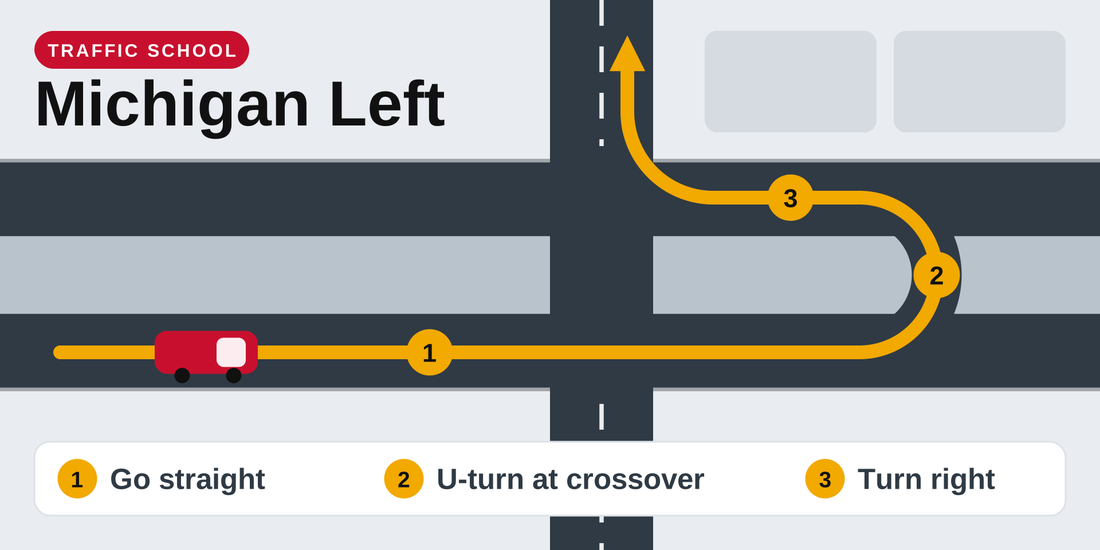
Ever turned left by turning right first? That’s a Michigan Left, and it works.
It sounds backwards at first, but it’s a well-tested traffic engineering design that replaces the direct left-turn lane with a right turn and a U-turn. Named for its long use on Michigan roads, it is also called a “median U-turn” or a “thru-turn intersection,” and you may have driven through one without realizing it.
How a Michigan Left works
Say you want to turn left off a divided highway. At a conventional intersection, you would use a dedicated left-turn lane, with signs and signals for that intersection. At a Michigan Left, the turn is handled differently:
- Turning left from the main road: drive straight through the intersection, make a U-turn at the median crossover just beyond it, then come back and turn right.
- Turning left from the side road: turn right onto the main road, make a U-turn at the crossover downstream, then drive straight through the intersection.
It can feel like going out of your way, but it takes the left turn across oncoming traffic out of the intersection itself.
Why engineers use it
Left-turn crashes account for more than 20 percent of fatal crashes at signalized intersections, according to the Federal Highway Administration (FHWA), and the median U-turn is designed to address that. Michigan has used the design for more than 30 years, and the FHWA lists it among its Proven Safety Countermeasures. In a study of eight Michigan roadway sections from 1991 to 1997, researchers found average reductions of 31 percent in total crashes and 32 percent in injury crashes. The FHWA also reports that the design can improve intersection throughput by 20 to 50 percent compared with direct left turns.
Closer to home: Michigan Lefts in Indiana
Fishers opened what was believed to be Indiana’s first Michigan Left in 2013, at 96th Street and Allisonville Road. Many drivers never warmed to it, and the city has since replaced it with a roundabout as part of a redevelopment of that corner (WTHR). The Indiana Department of Transportation has had a better experience: since 2015 it has installed seven Michigan Lefts at four-lane highway intersections and, as reported by IndyStar, found average reductions of 81 percent in fatal and injury crashes and 58 percent in property-damage crashes.
Where signs come in
Any design that asks drivers to do something unexpected depends on clear signing. Directional, lane-use, and turn-restriction signs tell drivers where to go and what to expect. Browse our regulatory signs and guide signs, or request a quote for your project.
Have you driven through a Michigan Left? We’d like to hear about it. Share your story on our Facebook page.
Share: