
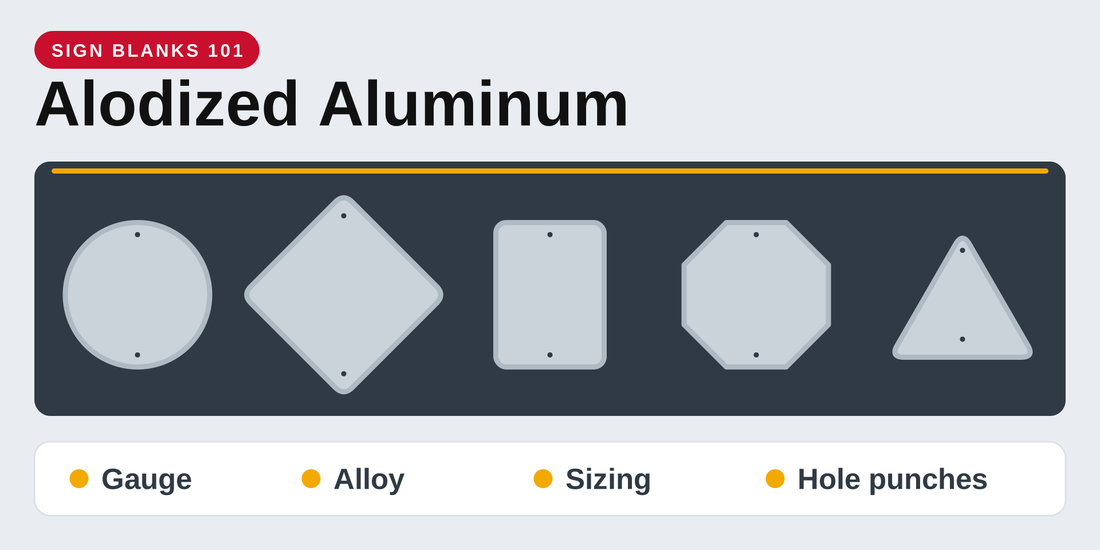
Not sure which aluminum sign blank is right for your project? Start here.
Welcome to the first post in our Sign Blanks 101 series. We offer quite a few blank options, so we’re beginning with the most basic: alodized aluminum sign blanks.
What is an alodized aluminum blank?
Our aluminum sign blanks are bare metal: no paint, vinyl, or reflective sheeting is applied, so you can finish them however your project requires. Aluminum is the go-to material for permanent traffic signs, and every blank is alodized, meaning it is chemically treated to resist corrosion and prepare the surface for paint or reflective sheeting. Our treatment follows ASTM B449, the standard specification for chromate conversion coatings on aluminum.
We cut every blank at our Bloomington, Indiana facility, with radius corners and mounting holes that follow the Federal Highway Administration’s Standard Highway Signs specifications.
Gauge and alloy
Aluminum comes in different thicknesses and alloy mixes. We call these the gauge and the alloy.
- Gauge: .080" is a common thickness for permanent traffic signs, and .063" is a lighter option. Many of our blanks are available in .063/3105, .080/3105, and .080/5052.
- Alloy: State DOT specifications commonly call for 5052-H38 or 6061-T6 under ASTM B209; Georgia DOT’s Section 912 is one example. 3M’s guidance for reflective sheeting likewise lists 5052-H38, 6061-T6, and 6063-T6, and notes that other alloys, such as 3105, may not resist corrosion well enough for some users’ durability expectations.
- Not sure which to choose? If your project has a specification, follow it. If it doesn’t, we’re happy to help you decide.
Quick facts
- Sizing: we list sizes with the horizontal dimension first, followed by the vertical dimension. This matters because, for most blanks, the size determines where the holes are punched. A 12" x 18" blank, for example, has holes punched in from the 12" side, top and bottom centered, so the sign is in “portrait” orientation.
- Hole punches: many sizes offer a choice of standard punch, punched both ways, or no holes.
- Phantom points: signs with rounded corners are often sized using “phantom points,” which mark where the corner would be if the edges extended out. On most shapes they don’t affect the sizing, but on triangles the actual measurements come out smaller than the phantom measurements.
- Custom sizes and shapes: because we cut every blank in Bloomington, we can cut just about any size and shape you need. Request a quote and tell us what you have in mind.
Have more questions? Contact us or call 800-284-7446, and we’ll be happy to walk you through the ordering process. Next up in Sign Blanks 101: our reflective aluminum blanks.
Share: